
How digital information gets "pinned" to a real spot in the kitchen — and the small devices that make that tracking rock-solid.
A spatial anchor pins a digital object to a real spot in the room — like taping a sticky note to the wall, except the headset remembers exactly where you put it, even after you leave and come back. For things that move — a tool, a piece of equipment — a small physical anchor device makes that tracking precise and reliable.
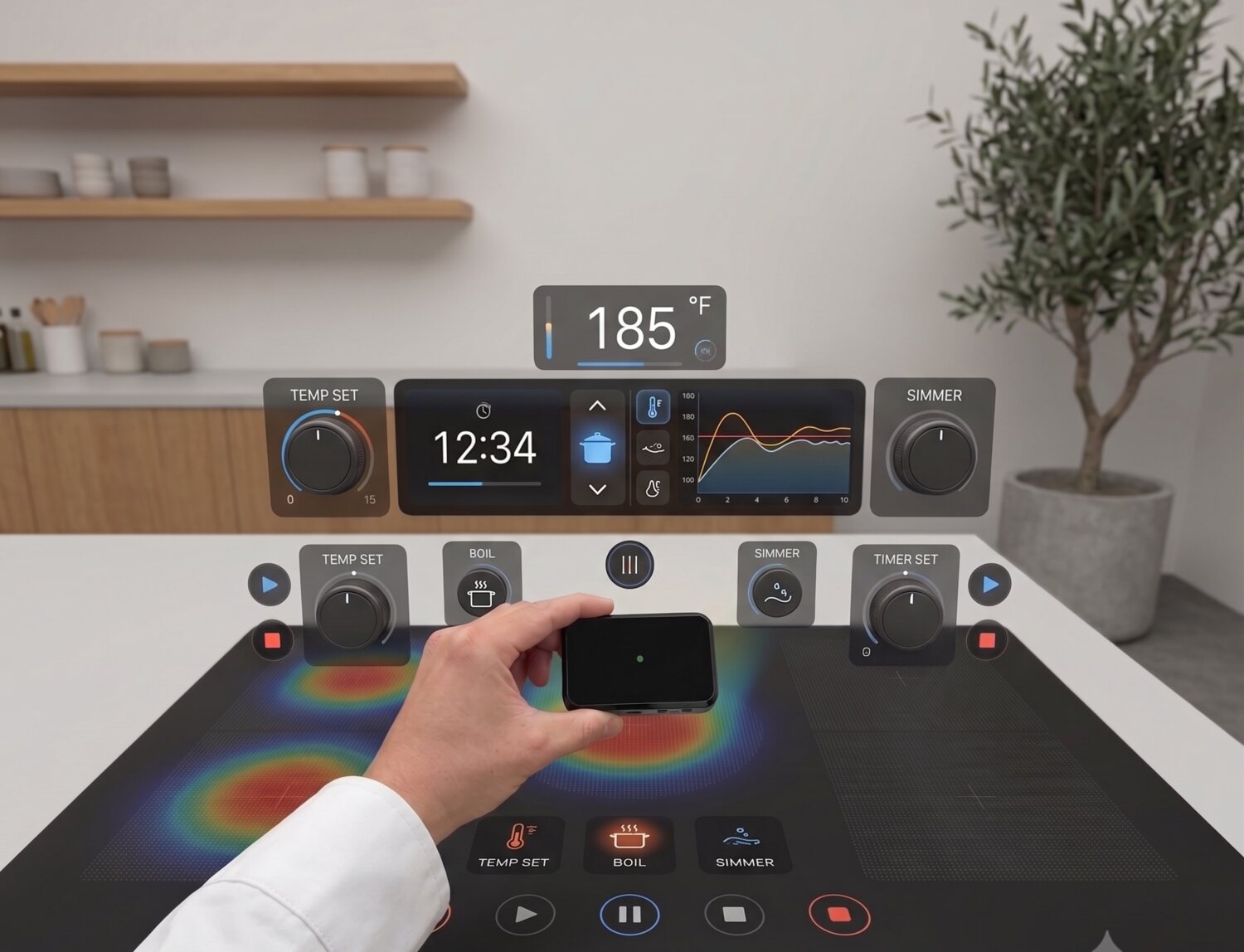
MIKROE's Spatial Anchor devices are purpose-built tracking beacons for Apple Vision Pro. Mount one to a real object and the headset can follow it in precise, real-time 6DoF — the exact capability a working kitchen needs.
Built for large objects — rigs, stations, and full setups. Eight infrared markers, a six-axis motion sensor, and Bluetooth tracking give it a rock-solid lock even through fast motion and partial cover. It plugs straight into Apple's visionOS accessory-tracking workflow.
A palm-sized version for smaller, handheld tools and accessories where size and weight matter. Four infrared markers and the same wireless, rechargeable design — small enough to embed almost anywhere.
The headset uses its cameras and motion sensors to build a mental map of the room — the same way you'd remember your own kitchen without thinking about it.
The system remembers the room itself, not just the moment. That's the idea behind our persistent safety zones — a warning glowing around the fryer is still exactly there tomorrow.
Multiple headsets or tablets can agree on the same anchored object at once — this is the idea behind our holographic whiteboard, where every student sees the same giant recipe sheet locked to the front wall.
A moving object — a tool, a piece of equipment — is harder for cameras alone to track. Sometimes a small physical tracker helps the system keep up with things that move, not just the room around them.
This is the more advanced, forward-looking half of our Spatial Computing work — the layer we're actively researching, alongside Digital Link, which is already live in the lab today.
Anchors handle tracking — but a full spatial kitchen also needs ways to interact. Here's the hardware we're watching.
Explore Spatial Accessories →